
Walking into an EAAP conference feels a little like coming home. Some of the faces are new. Many belong to people I have known for years, people I first met at this same gathering or years earlier.
This year I came with something to share. Humane Aviation Foundation brought its first poster to EAAP: a look at how aviation psychology and human factors are developing in India, and at the gap between what the system asks of its people and what it gives them in return. Here is what the poster said, and what the week gave back.
The poster: the human part of a fast-growing system
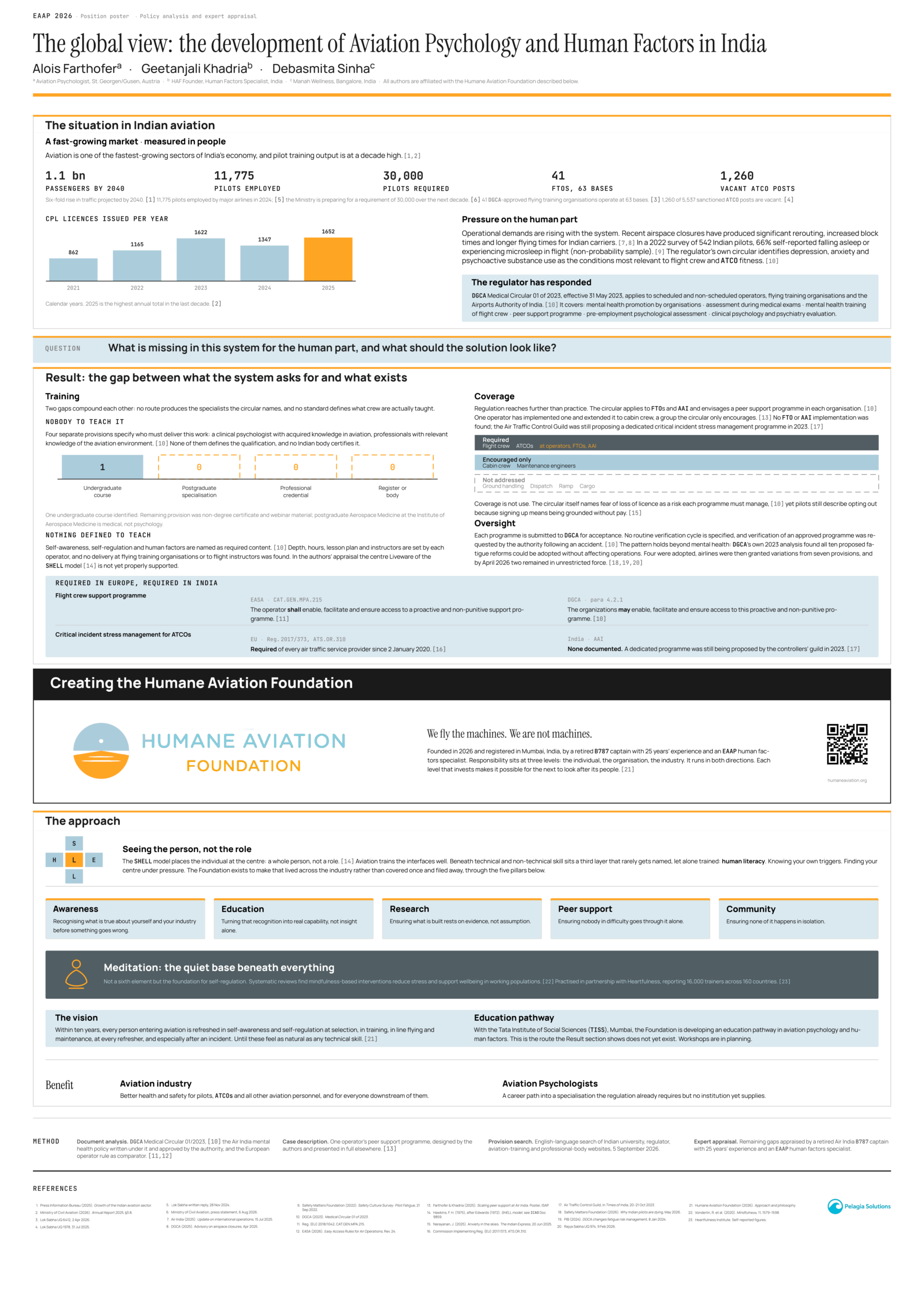
The global view: the development of Aviation Psychology and Human Factors in India, by Alois Farthofer, Geetanjali Khadria and Debasmita Sinha.
Indian aviation is growing at a pace few markets have seen. Passenger numbers are projected to reach 1.1 billion by 2040. Airlines employ around 11,775 pilots, and the Ministry is preparing for a need of 30,000 over the next decade. Behind those numbers are people: rerouted flights, longer duty days, and a 2022 survey in which two thirds of the pilots who responded reported falling asleep or experiencing microsleep in flight.
The regulator has responded. DGCA Medical Circular 01 of 2023 asks operators, flying schools and the Airports Authority of India to promote mental health, train crew, run peer support and give access to psychological care. That is a real step. So we asked a simple question: what is still missing for the human part of the system?
What we found is a gap between what the system asks for and what exists.
- Nobody to teach it. The circular calls for clinical psychologists with aviation knowledge, yet we found one undergraduate course in India, and no postgraduate specialisation, professional credential or register.
- Nothing defined to teach. Self-awareness, self-regulation and human factors are named as required content, but depth, hours and instructors are left to each operator.
- Coverage is not use. One operator has built a peer support programme and extended it to cabin crew. We found none at flying schools or air traffic control, and pilots still describe opting out for fear of being grounded without pay.
- Oversight is light. Programmes are accepted once, with no routine cycle to check they still work.
The second half of the poster is our answer. The SHELL model puts the person at the centre, and we believe the layer beneath technical and non-technical skill, what we call human literacy, deserves to be trained as seriously as the rest. That is why HAF works through five pillars, awareness, education, research, peer support and community, resting on a base of meditation. With the Tata Institute of Social Sciences in Mumbai, we are building an education pathway in aviation psychology and human factors, so the specialists the regulation already asks for can finally be trained at home.
The week itself
It was a privilege to be in a room with people from 35 countries. I moved between academic sessions and operational ones, and I valued how often the two spoke to each other. The security perspective stayed with me most. Philip Baum's presentation was thought-provoking on its own, and then, almost immediately afterwards, came the news of the Flydubai incident. Few moments make the link between research and the real world so plain.
I was also excited to learn about Flight Plan, the new mentorship initiative for future aviation psychologists. Seeing it reminded me why our poster matters: the profession needs a way in, and someone to walk beside the people taking it.
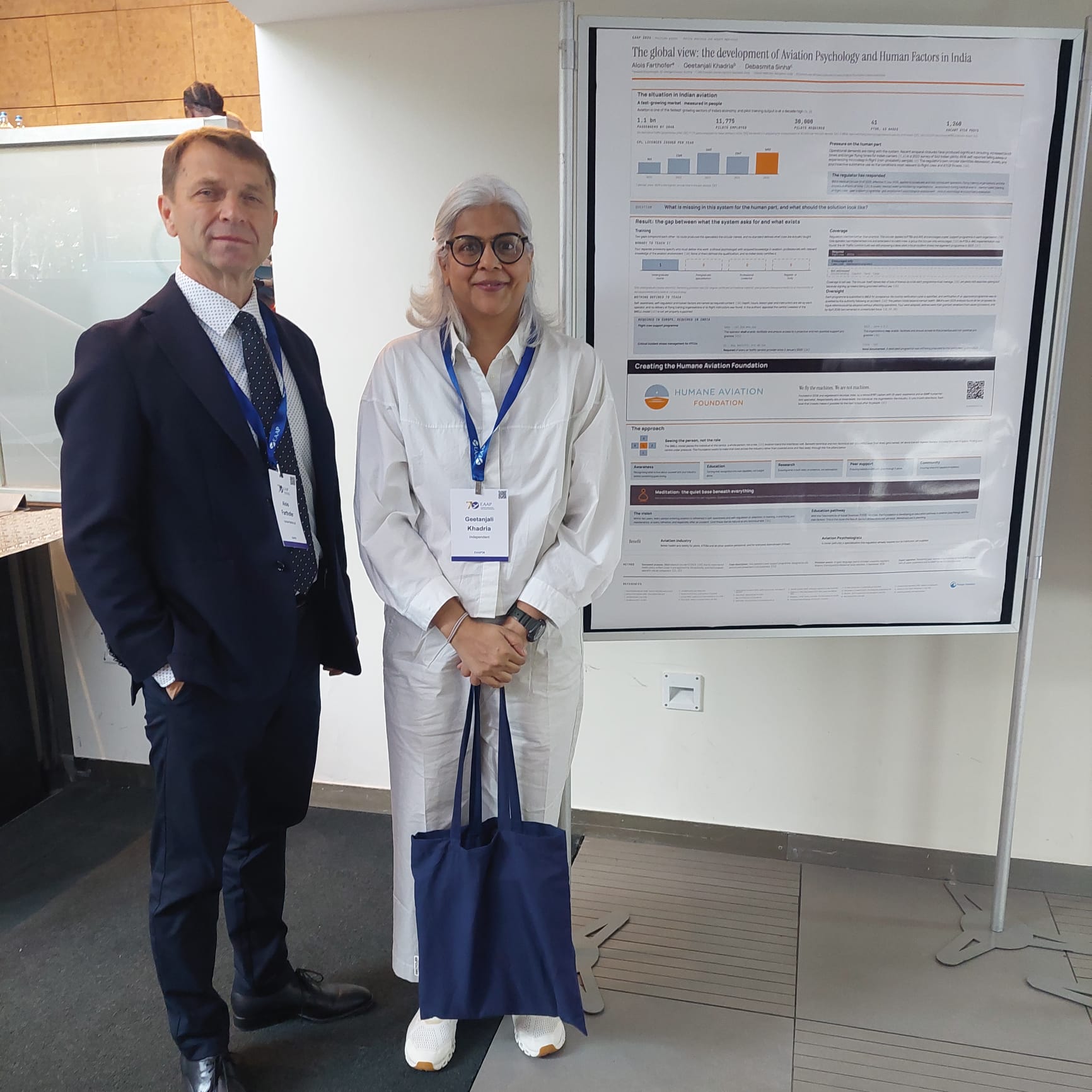
Our own poster generated encouraging interest, more than I had dared to hope for a first appearance. It was good to see real possibilities for collaboration begin to take shape.
What makes EAAP special
For me, though, EAAP has always been about more than the presentations. Every two years you come back, and you meet old friends. You pick up conversations where you left them. You make new connections, and sometimes, over a coffee, you find a way to work together that neither of you had planned.
We are grateful to the Italian Association of Aviation Psychology for collaborating with HAF. It was lovely, too, to reconnect with our friends from Turkey and with so many others across the community.
If I take one hope home with me, it is this: that we build stronger bridges between emerging and established aviation markets. Growth like India's needs the experience of others, and the established community has just as much to learn in return. I would love to see a more inclusive, more collaborative community, where knowledge and opportunities flow in both directions.
Why we keep coming back
Perhaps that is what keeps bringing us back. We come for the knowledge. But it is the relationships we build, and renew, that make this community endure.
Thank you to everyone who stopped by our poster, shared a thought, or simply said hello. See you at the next EAAP.
To learn more about Humane Aviation Foundation and our work, visit humaneaviation.org.

0 Comments